As we enter the holiday season, the PlumTree Financial team is embracing the spirit of gratitude, generosity, and giving back. This month, we explore key market developments beyond the headlines, highlight meaningful opportunities for charitable giving, honor our veterans, and recognize the caregivers who make a difference in our communities everyday.
Additional content provided by Adam Turnquist, Chief Cross-Asset Strategist.
The Setup
The votes have been cast. While control of the House and Senate has been decided, now we wait for the final tallies (and celebrate the end of the political ads — at least for another 20 months or so). We’re not political strategists, but policy does move markets, so it’s important to pay attention.
Before we get into potential policy implications of the midterms and the relationships between stocks and elections, our thinking on this election cycle — which has been correct at least up until now — is that the setup was not one for as much market volatility as we’ve endured historically (the average pre-midterms drawdown in the S&P 500 has been 17% and this year we’ve gotten 9%). The strong performance of the Democrats yesterday introduced some volatility in futures trading overnight, but markets calmed on the clarity this morning.
We would attribute the relative calm in broad stock market indexes over the past two months to strong economic growth and corporate profits, and the overwhelming anticipation of divided government. Divided government takes major sweeping tax and spending policies off the table and halts any of the more extreme policies of the political right and left. Further, some key policy objectives of the Trump administration can be executed via executive order and through regulatory bodies, reducing the influence of Congress (immigration, de-regulation, and tariffs to name a few, though Democrats in the next session of Congress are sure to push back on tariffs imposed unilaterally).
Some Important Policy Considerations
Here are several important policy implications from dividend government that could matter for select market segments:
Healthcare (Medicaid spending cuts) and consumer staples (SNAP funding). The major congressional questions surrounding these programs are how the timing of scheduled subsidies could affect consumer spending on the edges through a potential reversal of cuts to supplemental nutrition programs from a blue wave. A cohesive Democratic majority could also delay or reverse some healthcare spending cuts, potentially providing support for healthcare services while adding a bit to consumption in 2027 (Morgan Stanley estimates effects of 0.1% to 0.4%). Drug pricing will continue to get headlines, but the rules of the road limit price increases are already in place.
AI and data centers. AI and data center construction have become a very important post-election policy story. In divided government, the policy implications at the federal level may be limited, but data center policy decisions sit at the state and utility-commission level, making gubernatorial and utility races important alongside Congress, particularly Governor Abbott’s loss in Texas. LPL Research continues to expect the buildout to occur but strong performances by Democrats in key data center states (and pushback from the not in my backyard folks) may slow it down some, potentially increasing regulatory pressure on AI infrastructure stocks including semiconductors, machinery, and power generation.
Defense. Defense could benefit from bipartisan compromise, but gridlock creates funding risk. The possibility of a bipartisan budget deal in which Democrats get healthcare-related priorities while Republicans get additional defense funding does exist. Without a deal, repeated continuing resolutions would create a more difficult funding backdrop. This may be wishful thinking, but the upside potential for defense contractors seems feasible.
Banking deregulation. We do not expect the election results to reverse the trend of banking deregulation by the Trump administration. However, the strong performance by the Democrats will likely slow it down. Companies might try to rush mergers and acquisitions through in 2027 before the regulatory environment potentially gets tougher in 2028.
Treasury yields. Under gridlock in Washington, more fiscal expansion than is already on the books is unlikely. Another reconciliation bill to increase spending would have required a Republican sweep. On the other hand, divided government may imply less Treasury supply pressure and tempered rate volatility.
Seasonal Tailwinds: Will Risk Appetite Return to the Stock Market?
Midterm elections have historically served as an important clearing event for markets. In the weeks leading up to Election Day, political uncertainty tends to rise as investors assess potential changes in congressional control and the implications for fiscal policy, taxes, regulation, and other market-sensitive issues. The higher degree of uncertainty is often reflected in higher implied volatility, with the VIX typically building into the midterms as investors increase demand for portfolio protection.
However, once the election is over and the clouds of uncertainty part, investors can stop worrying about what might happen and start positioning around what did. The reduction in event risk can help unwind defensive positioning, reduce demand for hedges, and bring risk appetite back to the table. The potential resetting of sentiment could come at an opportune time as the S&P 500 hovers near the lower end of its multi-month trading range.
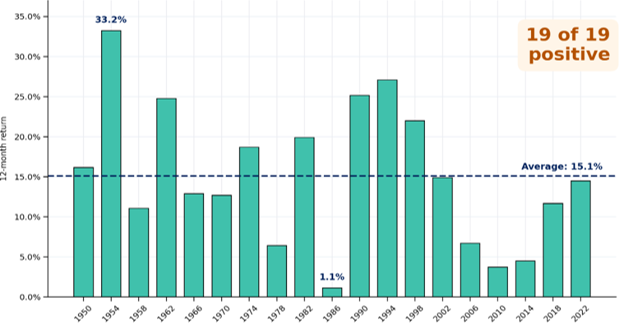
History is on the market’s side. Going back to 1950, the S&P 500 has gained an average of 15.1% over the 12 months following midterm Election Day, with all 19 periods producing positive returns. Even the weakest outcome remained positive: following the 1986 midterms, the S&P 500 gained 1.1% over the next 12 months, despite that window including the October 1987 stock market crash.
Political Opinions are Best Expressed at the Polls, Not in your Portfolio
What happens in Washington, D.C., can play an important role in our daily lives, and help shape the country in many ways, but politics alone does not drive the economy or the stock market. There are other more powerful macro forces that drive economic expansions and contractions, such as the health of corporate earnings, consumer spending, inflation, interest rates, credit conditions, and monetary policy. Today, that list also includes the secular AI investment cycle, which has become an increasingly important contributor to market performance, earnings growth, and economic activity.
S&P 500 Post-12-Month Midterm Election Day Performance
Source: LPL Research, Bloomberg, 11/03/26
Disclosures: All indexes are unmanaged and cannot be invested in directly. Past performance is no guarantee of future results. The modern design of the S&P 500 stock index was first launched in 1957. Performance back to 1950 incorporates the performance of the predecessor index, the S&P 90.
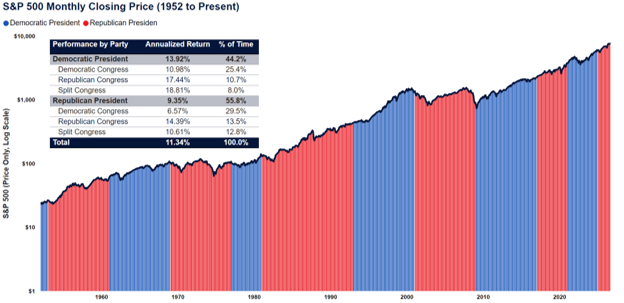
For the long-term investor, we believe political opinions are best expressed at the polls and not in portfolios. As highlighted in the “Stocks Do Well Under Various Political Combinations” chart, the S&P 500 has historically been able to advance under a variety of political configurations because, over longer horizons, drivers such as economic growth and corporate profitability have mattered far more than party labels.
Stocks Do Well Under Various Political Combinations
Source: LPL Research, Bloomberg, 11/03/26
Disclosures: All indexes are unmanaged and cannot be invested in directly. Past performance is no guarantee of future results. The modern design of the S&P 500 stock index was first launched in 1957. Performance back to 1950 incorporates the performance of the predecessor index, the S&P 90.
So, from a broad economic and market perspective, under divided government, there was not as much on the line this election in terms of policy implications as in previous cycles. There will be a lot on the line in 2028, where market participants will turn their attention right away. But for now, we would focus on the strong seasonal tailwind at the back of this market, the solid economic growth outlook with, we believe, favorable prospects inflation to begin to come down after New Year’s, and the benefits of AI adoption which are becoming more apparent every day.
Did You Know?
Year-End Charitable Gifting and You
Are you making charitable donations at year's end? If so, you should know about some of the financial "fine print" involved, as the right moves could potentially bring more of a benefit to both you and your chosen charity.
Keep in mind, this article is for informational purposes only and is not a replacement for real-life advice. Make sure to consult your tax, legal, or accounting professionals before modifying your charitable gifting strategy.
Evaluate the Impact
How can you maximize the impact of your gifts? First, consider giving to a qualified charity with 501(c)(3) nonprofit status. Also, Charity Navigator, Charity Watch, and Give Well have websites that offer information to help you evaluate a charity and learn about how effectively it utilizes donations. If you are considering a large donation, it is often wise to ask the charity involved how it will use your gift.
If you're still working, you may want to check with your employer. Some companies match charitable contributions made by their employees, an often-overlooked opportunity to give back.
Itemize to Optimize
To deduct charitable donations, you must itemize them on IRS Schedule A. So, you'll need to log each donation you make. Ideally, the charity will provide you with a form to document proof of your contribution. If the charity does not have such a form handy (and some do not), a receipt, a credit or debit card statement, a bank statement, or a canceled check can work. The IRS may want to know three things: the name of the charity, the gifted amount, and the date of your gift.1
Remember, itemized deductions may only have tax benefits when they exceed the standard income tax deduction, so be sure to check on the standard deduction amount for your tax filing year.
Show Your Appreciation
Many charities welcome non-cash donations. In fact, donating an appreciated asset can be a tax-savvy move. You may wish to explore a gift of highly appreciated securities. Selling securities can lead to a taxable event. As an alternative, you or a financial professional can write a letter of instruction to a bank or brokerage, which can facilitate authorizing a transfer of shares to a charity.
This transfer can accomplish three things:
You can manage paying the tax you would normally pay upon selling the shares.
You may be able to take a current-year tax deduction for the full fair market value of the shares.
The charity gets the full value of the shares, not their after-tax net value. This can be a winning strategy all around.1
A Policy of Giving Back
Do you have a life insurance policy? If you make an irrevocable gift of that policy to a qualified charity, you can get a current-year income tax deduction. If you keep paying the policy premiums, each payment may become a deductible charitable donation. (Deduction limits can apply.) If you pay premiums for at least three years after the gift, that could reduce the size of your taxable estate. The death benefit may be transferred out of your taxable estate, in any case.1
You should consider determining whether you are insurable before implementing a strategy involving life insurance. Any guarantees associated with a policy are dependent on the ability of the issuing insurance company to continue making claim payments. Several factors will affect the cost and availability of life insurance, including age, health, and the type and amount of insurance purchased. Life insurance policies have expenses, including mortality and other charges. If a policy is surrendered prematurely, the policyholder may also pay surrender charges and have income tax implications.
Whatever your situation, getting advice from a tax or financial professional can help you give wisely as the year comes to a close. We're here to help find a strategy that works for your situation.
Hanging out with us in the Plum Tree!
Gratitude, Family, and Planning for the Future
November is a season of gratitude, family gatherings, and reflection. As loved ones come together to celebrate traditions and make memories, it is a natural time to think about the people and values that matter most.
At PlumTree Financial, we believe wealth management is about more than investments. It is about helping individuals and families prepare for the future, navigate life's transitions, and work toward the goals that are most important to them. Many of the conversations we have with clients center around family, legacy, and creating a lasting impact for future generations.
This time of year reminds us that some of life's greatest blessings are not measured in dollars and cents, but in the relationships we build, the memories we share, and the peace of mind that comes from knowing those we care about are prepared for whatever the future may bring.
As we enter the holiday season, the PlumTree Financial team wants to express our sincere gratitude for the trust our clients place in us. We are also excited to continue one of our favorite November traditions, our Annual Pie Giveaway & Open House on November 24 from 1:00-4:00 p.m. It is a wonderful opportunity for our team to connect with clients, share our appreciation, and celebrate the season together.
We wish you and your family a Happy Thanksgiving filled with gratitude, joy, and meaningful moments with those you cherish most.
November brings together several meaningful observances that recognize the people who serve, support, and care for others. As we observe Veterans Day, Military Family Month, National Family Caregivers Month, and National Long-Term Care Awareness Month, we honor the dedication, resilience, and compassion that strengthen our communities every day.
Veterans have served our nation with courage and commitment, while military families provide the steadfast support that makes that service possible. Family caregivers and long-term care professionals likewise make a profound difference in the lives of those they assist, helping loved ones maintain dignity, independence, and quality of life.
While these observances recognize different groups, they share a common theme: selfless service. Whether serving our country, supporting a military family, caring for an aging parent, or assisting those with long-term care needs, these individuals demonstrate an extraordinary commitment to others.
November is also an opportunity to show our appreciation through action. A simple thank you, a helping hand, or support for organizations serving these communities can make a meaningful impact. Small acts of kindness often provide encouragement to those who spend so much of their time caring for others.
As we reflect on these observances throughout the month, we extend our heartfelt gratitude to all veterans, military families, caregivers, and care professionals. Thank you for your service, sacrifice, and unwavering commitment to those who depend on you.
Helpful Resources
U.S. Department of Veterans Affairs (VA): https://www.va.gov/
Military One Source: https://www.militaryonesource.mil
National Alliance for Caregiving: https://www.caregiving.org/
Family Caregiver Alliance: https://www.caregiver.org/
Administration for Community Living (Eldercare Locator): https://eldercare.acl.gov/home
Upcoming Events
Save the Date
November 24, 2026 |1pm - 4pm EST
Celebrating 10 Years of Thanksgiving Pie, Gratitude & Community
Stop by our office between 1pm - 4pm and enjoy a cup of hot cider, or hot cocoa, some fall treats...and of course, pick-up your pie (feel free to drop by even if you are not picking up a pie).
Choose from Apple, Pecan, Pumpkin OR choose Donate, and PlumTree Financial will make a donation for the value of your pie to one of the following charities: Food for Others or Pathway Homes.
Deadline to select your pie is Friday, November 20, 2026.
For additional information or to RSVP click link below.
Save the Date! LPL Research Market Outlook 2027 Webinar
Get ready for our 2027 Market Outlook webinar - a forward-looking discussion on what is next for the markets, the economy, and your investment strategies.
For more details or to register, click the link below.
We moved: 8100 Boone Blvd, Suite 420, Vienna, VA 22182.
We are excited to showcase our new office and celebrate this new milestone with our clients.
Additional details coming soon.
Grateful for today. Prepared for tomorrow.
Worth Your Salt means deserving of one's pay or compensation through hard work and contribution. The phrase dates back to ancient times when salt was a highly valued commodity and, according to popular belief, was associated with compensation for Roman soldiers. In fact, the word salary is believed to derive from the Latin word salarium, which was connected to salt allowances. Today, the expression reminds us that building wealth often begins with recognizing the value of hard work, developing our skills, and making the most of our earning potential.
Disclosures
Beyond the Ballots: What Matters for Markets
This material is for general information only and is not intended to provide specific advice or recommendations for any individual. There is no assurance that the views or strategies discussed are suitable for all investors. To determine which investment(s) may be appropriate for you, please consult your financial professional prior to investing.
Investing involves risks including possible loss of principal. No investment strategy or risk management technique can guarantee return or eliminate risk.
Indexes are unmanaged and cannot be invested into directly. Index performance is not indicative of the performance of any investment and does not reflect fees, expenses, or sales charges. All performance referenced is historical and is no guarantee of future results.
This material was prepared by LPL Financial, LLC. All information is believed to be from reliable sources; however LPL Financial makes no representation as to its completeness or accuracy.
Unless otherwise stated LPL Financial and the third party persons and firms mentioned are not affiliates of each other and make no representation with respect to each other. Any company names noted herein are for educational purposes only and not an indication of trading intent or a solicitation of their products or services.
Asset Class Disclosures –
International investing involves special risks such as currency fluctuation and political instability and may not be suitable for all investors. These risks are often heightened for investments in emerging markets.
Bonds are subject to market and interest rate risk if sold prior to maturity.
Municipal bonds are subject and market and interest rate risk and potentially capital gains tax if sold prior to maturity. Interest income may be subject to the alternative minimum tax. Municipal bonds are federally tax-free but other state and local taxes may apply.
Preferred stock dividends are paid at the discretion of the issuing company. Preferred stocks are subject to interest rate and credit risk. They may be subject to a call features.
Alternative investments may not be suitable for all investors and involve special risks such as leveraging the investment, potential adverse market forces, regulatory changes and potentially illiquidity. The strategies employed in the management of alternative investments may accelerate the velocity of potential losses.
Mortgage backed securities are subject to credit, default, prepayment, extension, market and interest rate risk.
High yield/junk bonds (grade BB or below) are below investment grade securities, and are subject to higher interest rate, credit, and liquidity risks than those graded BBB and above. They generally should be part of a diversified portfolio for sophisticated investors.
Precious metal investing involves greater fluctuation and potential for losses.
The fast price swings of commodities will result in significant volatility in an investor's holdings.
This research material has been prepared by LPL Financial LLC.
Not Insured by FDIC/NCUA or Any Other Government Agency | Not Bank/Credit Union Deposits or Obligations | Not Bank/Credit Union Guaranteed | May Lose Value
For Public Use – Tracking: #1202423
Year-End Charitable Gifting and Your
Source: 1. IRS.gov, 2025
The content is developed from sources believed to be providing accurate information. The information in this material is not intended as tax or legal advice. It may not be used for the purpose of avoiding any federal tax penalties. Please consult legal or tax professionals for specific information regarding your individual situation. This material was developed and produced by FMG Suite to provide information on a topic that may be of interest. FMG, LLC, is not affiliated with LPL Financial or PlumTree Financial. The opinions expressed and material provided are for general information, and should not be considered a solicitation for the purchase or sale of any security. Copyright FMG Suite.
Securities and Advisory services offered through LPL Financial, a Registered Investment Advisor, Member FINRA/SIPC. Insurance products offered through LPL Financial or its licensed affiliates.
All information is believed to be from reliable sources; however, PlumTree Financial makes no representation as to its completeness or accuracy.
PlumTree Financial, Inc. | 8100 Boone Blvd. Suite 420 | Vienna, VA 22182 US