After a brief summer hiatus, we are back with a full September issue packed with timely insights and updates. With so much attention on next week's Federal Reserve meeting, we revisit historical market behavior to explore how stocks have tended to respond following initial rate hikes. We also share what you need to know about Trump Accounts, highlight our recent Client Appreciation Event, and introduce our new office space. You will also find details on upcoming webinars and gatherings in our Upcoming Events section as we head into a busy and engaging fall season.
September 2026
Capital Markets
How Stocks Performed Historically After Initial Fed Rate Hikes?
With so much attention focused on what the Federal Reserve (Fed) might do at its policy meeting next week, it’s a good time to look back at history to get a sense of how stocks might respond should the Fed hike rates as the market (barely) expects. LPL Research had been characterizing the rate decision as a coin flip until Chair Warsh’s hawkish comments at the Jackson Hole meeting and the strong August jobs report released last week. With the Fed fund futures market pegging the odds of a hike at 61% currently, we now believe the odds do, ever so slightly, favor a hike.
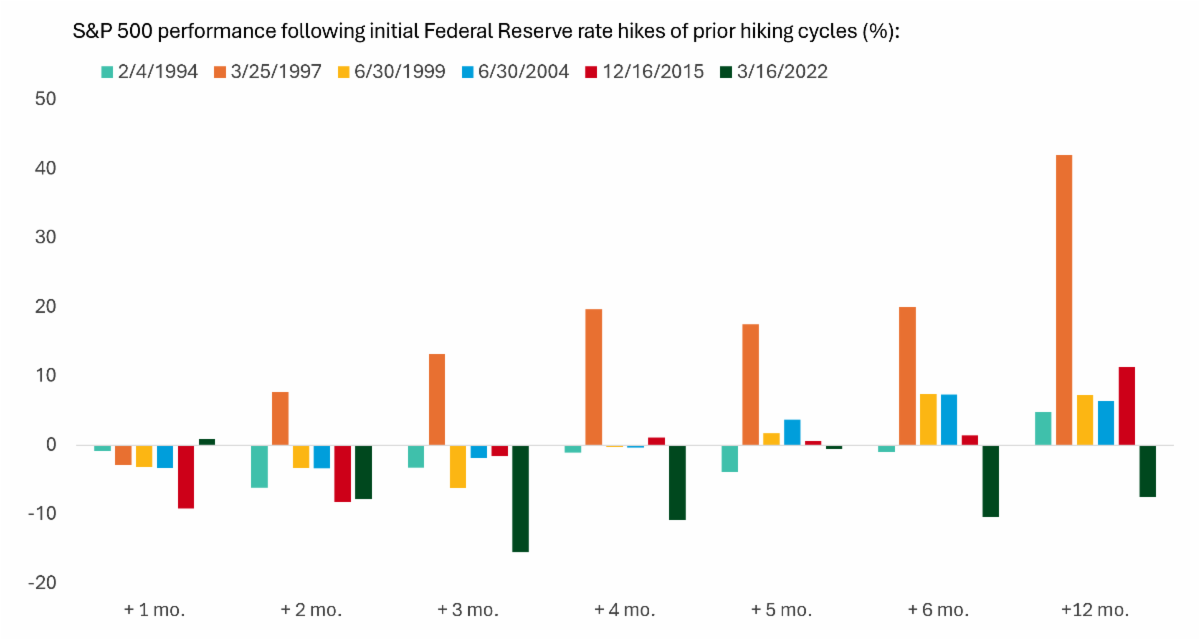
To get a sense of how stocks might react if the Fed does indeed hike next week, we looked back at how the S&P 500 performed after initial Fed rate hikes over the past 30 years. As illustrated in the “Initial Fed Rate Hikes Have Generally Been Well Tolerated by the Stock Market” chart, it’s clear that stocks typically struggle for a few months before regaining their footing about five months out.
Initial Fed Rate Hikes Have Generally Been Well Tolerated by the Stock Market
Source: LPL Research, Bloomberg, 09/08/26
Disclosures: Past performance is no guarantee of future results. All indexes are unmanaged and cannot be invested in directly.
During the six tightening cycles since 1994, stocks generally struggled during the first several months following the initial rate increase. On average, returns were negative through the first four months before improving significantly by five to six months after the initial hike.
Importantly, those early challenges have not typically translated into longer-term losses. In most cases, equity markets ultimately recovered and delivered healthy returns over the subsequent 12 months as investors adjusted to higher borrowing costs and focused on the underlying strength of the economy and earnings. The average 12-month gain for the S&P 500 post-hike is 6.7%, with a median of 10.7%. It’s important to use the median statistic in this case because of the 42% gain in the S&P 500 after the initial rate hike in March 1997. More on that below.
Two Notable Exceptions
Among these historical analogues, two periods stand out for different reasons. First, the bad news. After the initial hike in March 2022, the S&P 500 fell over the subsequent two months and stayed down for more than 12 months. Stocks faced a uniquely difficult backdrop, with long-term rates rising from severely depressed levels as inflation surged to multi-decade highs following the pandemic. The Fed was late to respond (remember how “transitory” became a bad word?) and was forced to tighten aggressively to catch up. The Fed’s poor track record of “hiking until something breaks” left markets fearful that a recession was in the offing. Not only did it feel like a recession to most consumers and investors, but the stock market’s 25% drawdown was consistent with one. Although the U.S. economy did not technically enter a recession in 2022, the environment today is clearly much different than it was then.
The second notable exception to the general trends noted above came in 1997, when stocks significantly outperformed the other tightening cycles. Not only was the S&P 500 up nearly 8% two months later as the dot-com boom picked up speed, but a year after that initial hike, the S&P 500 was up 42%! Internet optimism carried the day, not too dissimilar from the AI-driven environment we are in today. In the battle between higher interest rates and revolutionary technologies, technology can win for a while. In fact, another hike in 1999 was followed by another 12-month gain in the S&P 500, reminding us how long the bubble inflated before it eventually popped in the spring of 2000.
Some observers point to the Fed's June 1999 rate hike as a catalyst for the eventual bursting of the bubble. While we would acknowledge that tighter monetary policy likely contributed to market volatility, the enormous level of speculative investment and excessive capital spending would likely have ended that cycle at around the same time regardless of monetary policy actions.
Lessons Learned
The key lesson from these prior cycles is that rate hikes do not typically derail bull markets. When rate increases coincide with rising recession risks, that’s a different story. Today, recession risks are low by all accounts. Economic growth remains solid, labor markets remain healthy (as reinforced by last week’s jobs report), and inflation, though high, is far below the peaks reached in 2022. Meanwhile, interest rates are already much higher than they were at the start of the last tightening cycle, reducing the shock value for bond portfolios in the case of modest additional increases in market-based rates like the 10-year Treasury.
While we won’t forecast a 40% rally in the next year, whether we get a hike next week or not, it’s clear to us that the current environment shares more characteristics with the late-1990s experience than the challenges of 2022. While no historical period offers a perfect comparison, today's combination of economic resilience and moderating inflation suggests the backdrop for equities remains supportive. History rhymes. We might get one hike. We might get two. But we won’t get 5.25% worth as we did in 2022 and 2023 (that’s the equivalent of 21 quarter-point hikes, but who’s counting?).
The Bottom Line
Markets expect Fed Chair Kevin Warsh and his Federal Open Market Committee (FOMC) colleagues to raise rates next week, and potentially again by December or in the first quarter of 2027. While additional hikes could create periods of volatility, history suggests that strong economic fundamentals can help offset the headwinds from higher rates. During past tightening cycles, stocks often experienced initial turbulence following the initial rate increase before regaining their footing. As long as economic growth remains intact and recession risks stay contained, equity markets have historically been able to move higher even in a rising-rate environment.
Did You Know?
Trump Accounts - What You Need to Know
As part of the recently enacted “One Big, Beautiful Bill Act” (OBBBA), Congress introduced a new type of child-focused savings vehicle called a “Trump Account” designed to help families invest in their children’s financial futures. Trump Accounts went live on July 4, 2026, and can now be established and funded. Below are facts advisors and investors need to know as they discuss and consider Trump Accounts. We are expecting to see additional regulations roll out and will send additional information as we receive them.
What is a Trump Account? A government-sponsored savings vehicle modeled as a variation of Individual Retirement Accounts (IRAs) under Section 408(a) of the Internal Revenue Code.
The Trump Accounts must be established through Treasury and their initial custodian, Robinhood. Guardians will be able to track the accounts online and see information on an interactive app the Treasury Department released in June.
What does 530A refer to? 530A is another name for Trump Accounts and is referring to the section of OBBBA that established the program. Some experts are beginning to use it when talking about Trump Accounts to align them
more closely to other names, such as 401(k)s and 529s, etc.
Who is eligible for a Trump Account? To be eligible for a Trump Account, the child must:
a. Be a U.S. citizen
b. Have a Social Security number
c. Under the age of 18
d. A child for whom no prior Trump Account pilot program election has been made and processed
Who can open a Trump Account? The election to open an account can be made by an “authorized individual” or the Treasury Secretary. The ordering framework from highest to lowest priority for who can make the election is a legal guardian, a parent, an adult sibling, or a grandparent of the beneficiary. Under the rules, the individual electing to open the account on behalf of a beneficiary must represent that there is no person with higher priority available to make the election.
If an election was made by an individual who was not an authorized individual, the Treasury Secretary “is deemed to have made the election to open the Trump Account.” Treasury will not auto enroll qualified children because it would violate disclosure of taxpayer information.
If the authorized individual of an open Trump Account needs to be replaced, the proposed rules specify that applicable state and federal law or the account agreement will outline next steps. The authorized individual has authority to make investment choices, as well as request to rollover the Trump Account to another brokerage or private bank or request a transfer for a qualified ABLE rollover contribution.
A child welfare agency of a state that is the legal guardian of an eligible child with a social security number may elect to open an initial Trump Account for that child. The IRS is working with each state to provide guidance and ensure agencies have the necessary information to successfully complete this process.
What is the Trump Account Pilot Program? To be eligible for the pilot program $1,000 contribution from the U.S. Treasury, the child must be born between January 1, 2025, and December 31, 2028. Form 4547 includes an option for an individual to request the $1,000 pilot contribution.
The pilot program election must be filed by a parent or guardian with a qualifying child for the year the election is made. Treasury noted that expecting parents may want to make an election and could be able to do so before the tax year that the child is born.
How is the $1,000 Pilot Program contribution distributed? When the pilot program election for the contribution is made, the child will be treated as making a $1,000 payment against a federal income tax liability, resulting in a $1,000 overpayment, which will then be refunded as a pilot program contribution to the child’s Trump Account.
Since overpayment amounts can be offset by taxes owed, but the statute requires a full $1,000 payment to a child’s Trump Account, the pilot program election is made for the child’s “special taxable year” rather than the calendar year.
No $1,000 refund will be paid except as a contribution to the child’s Trump Account. If a pilot program election is made for a child without a Trump Account, the child will not receive the $1,000 refund from Treasury.
What are the investment requirements? Funds must be invested in U.S. equity index funds that track the stock market and managers cannot charge more than 0.10% in annual fees. For now, all contributions will be invested in the funds specified by the IRS. In the coming months, Treasury expects to allow parents to choose how to allocate funds across additional eligible investment options selected by Treasury.
What are the contribution limits? The maximum annual contribution will be $5,000 and indexed to inflation beginning in 2028. Contributions will generally be made with after-tax dollars. Treasury is currently working on guidance on whether the contribution will count against the gift tax limit.
Parents’ employers can contribute but are capped at $2,500 per employee, pre-tax. Treasury is working with the major payroll companies on how to execute the program for employers who want to offer it.
Contributions from governments and charities do not count towards the $5,000 total, which will be distributed by the Treasury Department.
In June, Treasury released an initiative providing flexibility for states to deposit federal survivor benefits into Trump Accounts of foster children. These contributions count towards the annual contribution limit of $5,000 per account.
In early July, Treasury announced that philanthropic stock contributions will be allowed for Trump Accounts. Such stock must be readily tradable public company stock.
What about children born before 2025? Children born before Jan. 1, 2025 and under 18 are still eligible but won’t qualify for the $1,000 incentive. Parents can still invest up to $2,500 pretax for those kids, and they may benefit from the Dells’ donation, giving $250 to children 10 and under in zip codes where the median income is less than $150,000, the Dalio’s donation to children in zip codes with the same income restriction in Connecticut, or new philanthropic contributions.
Does the Gift Tax apply to Trump Accounts? The guidance creates a safe harbor for donors to Trump Accounts. Donors generally must file Form 709, U.S. Gift (and Generation-Skipping Transfer) Tax Return, if a gift is not eligible for the annual exclusion under federal laws. Since Trump Account beneficiaries may not access the amounts in their Trump Accounts until age 18, it was unclear whether these were gifts of future interest which would not generally qualify for the gift tax exclusion thereby requiring the filing of Form 709. The revenue procedure explains that if the gift tax reporting safe harbor is met, then contributions are treated as completed gifts to the child instead of gifts of a future interest and such gifts would qualify for the annual gift tax exclusion. Accordingly, no Form 709 would need to be filed. In order to qualify for this safe harbor, the contribution to the Trump Account must meet the following requirements:
The donor must be an individual;
The only taxable gifts made during the year are cash contributions to one or more Trump Accounts;
Total gifts to each beneficiary do not exceed the annual gift tax exclusion, which is $19,000 in 2026 (indexed for inflation);
The contributions do not create gift tax or generation-skipping transfer tax liability; and
The donor is not otherwise required to file a gift tax return for that year aside from the Trump Account contributions.
If the requirements of the safe harbor are not met, the donor would be required to file a Form 709 for the year in which the gift was made.
What are the distribution rules? Trump Accounts do not permit any distributions until the beneficiary reaches age 18, making them more akin to a “starter IRA” for children, without the requirement of earned income. It can only be used for specific purposes, such as paying tuition, starting a business, unreimbursed medical expenses or making a down payment on a home. At age 18, the account becomes a traditional IRA.
Are there any exceptions? The exceptions to the no-distribution rule include:
a.Qualified Rollover Contributions: The entire balance can be transferred at any time to another Trump Account for the same beneficiary.
b.ABLE Account Rollovers: If the child is eligible for an ABLE account, the full balance of a Trump Account may be rolled over in the calendar year the child turns 17 and does not count towards the annual contribution limit for ABLE Accounts.
Who will manage Trump Accounts? The accounts must be established through the Treasury Department and their designated financial agent and custodian (BNY and Robinhood), but parents and guardians eventually will be able to transfer the accounts to a private bank or brokerage. Treasury is planning to release guidance on rollover capabilities shortly after the launch of the program.
Are Trump Accounts available now? Yes, parents of eligible kids are able to sign up by filling out Form 4547 from the IRS. Contributions began to be accepted on July 4.
How should parents protect themselves from scams? Treasury will only be sending communication by email from no-reply@TrumpAccounts.Treasury.gov and will not contact parents or guardians through phone or text message. If there is a need to reach customer support, Treasury instructs families to utilize the secure in-app contact portal or through online callback request.
Are there additional resources? Trump Accounts - Jumpstarting the American Dream and Form 4547 (December 2025). Access using links below.
Client & Family Appreciation Event Highlights - Topgolf Loudoun
On August 30th, the Plums welcomed clients and friends to our Client Appreciation Event at Topgolf, where the relaxed daytime setting made for an enjoyable and engaging experience. The atmosphere was upbeat and social, giving everyone a chance to connect outside the office and enjoy a bit of friendly competition.
Guests moved through the hitting bays, shared plenty of laughs, and cheered one another on — whether they were seasoned golfers or trying Topgolf for the first time. The casual environment encouraged conversation, connection, and a chance to spend meaningful time with the individuals and families we serve.
Most importantly, the event reminded us how much we value the trust and partnership of our clients. We appreciate everyone who joined us and made the day memorable.
Featured Upcoming Webinar
Our next educational session, Maximize Your Medicare Experience, takes place on September 15, the first day of National Medicare Education Week. This webinar is designed to help individuals better understand Medicare options, enrollment timelines, and key considerations for making informed decisions.
For details and registration — along with information on additional upcoming webinars and events — please visit the Upcoming Events section of this newsletter.
Plum Picks: Where Petals Meet Passports
We Have Moved: PlumTree Financial Has a New Home
The Plums are excited to share that PlumTree Financial has officially moved into our new office at 8100 Boone Blvd, Suite 420, Vienna, VA.
Our new space is warm, modern, and filled with the signature purple plum aesthetic that reflects who we are. We are now right in the heart of Tysons, located in the Nostos building and directly across from Tysons Corner Center, making visits easier and more convenient for our clients.
From welcoming client areas to collaborative team spaces, the office gives us room to grow while staying true to the calm, thoughtful environment our clients appreciate. The move also allowed us to refine a few internal details, such as building access and private meeting spaces, to ensure conversations remain comfortable and confidential.
We look forward to welcoming you into the new space and sharing this next chapter with you. Please mark your calendars for our open house on Thursday, February 4, 2027.
Upcoming Events
Save the Date
September 15, 2026 | 12pm EST
Maximize Your Medicare Experience
Learn more about the importance of integrating Medicare strategy into your retirement plan.
Fresh season, clear insights. Stay informed and empowered.
Bulls and Bears - Few financial terms are as enduring—or as colorful—as "bull" and "bear." These market nicknames have been used for centuries to describe investor sentiment and the direction of financial markets, with references appearing in England as early as the 18th century.
The term "bear" may have originated from a proverb about selling a bearskin before catching the bear—a warning against speculating on something you don't yet possess. Early traders who sold goods they had not yet acquired were sometimes called "bearskin jobbers," and over time the term became associated with those expecting prices to fall. The origin of "bull" is less clear, though it is commonly linked to the animal's upward thrusting horns, which came to symbolize rising markets and optimism.
Today, bulls and bears represent opposing market outlooks. Bulls expect prices to rise and are generally optimistic about economic growth, while bears anticipate declines and take a more cautious view.
Whether markets are charging ahead or hunkering down, these centuries-old terms remain a powerful reminder that investor psychology has always played a role in shaping financial markets.
Disclosures
How Stocks Performed Historically After Initial Fed Rate Hikes?
This material is for general information only and is not intended to provide specific advice or recommendations for any individual. There is no assurance that the views or strategies discussed are suitable for all investors. To determine which investment(s) may be appropriate for you, please consult your financial professional prior to investing.
Investing involves risks including possible loss of principal. No investment strategy or risk management technique can guarantee return or eliminate risk.
Indexes are unmanaged and cannot be invested into directly. Index performance is not indicative of the performance of any investment and does not reflect fees, expenses, or sales charges. All performance referenced is historical and is no guarantee of future results.
This material was prepared by LPL Financial, LLC. All information is believed to be from reliable sources; however LPL Financial makes no representation as to its completeness or accuracy.
Unless otherwise stated LPL Financial and the third party persons and firms mentioned are not affiliates of each other and make no representation with respect to each other. Any company names noted herein are for educational purposes only and not an indication of trading intent or a solicitation of their products or services.
Asset Class Disclosures –
International investing involves special risks such as currency fluctuation and political instability and may not be suitable for all investors. These risks are often heightened for investments in emerging markets.
Bonds are subject to market and interest rate risk if sold prior to maturity.
Municipal bonds are subject and market and interest rate risk and potentially capital gains tax if sold prior to maturity. Interest income may be subject to the alternative minimum tax. Municipal bonds are federally tax-free but other state and local taxes may apply.
Preferred stock dividends are paid at the discretion of the issuing company. Preferred stocks are subject to interest rate and credit risk. They may be subject to a call features.
Alternative investments may not be suitable for all investors and involve special risks such as leveraging the investment, potential adverse market forces, regulatory changes and potentially illiquidity. The strategies employed in the management of alternative investments may accelerate the velocity of potential losses.
Mortgage backed securities are subject to credit, default, prepayment, extension, market and interest rate risk.
High yield/junk bonds (grade BB or below) are below investment grade securities, and are subject to higher interest rate, credit, and liquidity risks than those graded BBB and above. They generally should be part of a diversified portfolio for sophisticated investors.
Precious metal investing involves greater fluctuation and potential for losses.
The fast price swings of commodities will result in significant volatility in an investor's holdings.
This research material has been prepared by LPL Financial LLC.
Not Insured by FDIC/NCUA or Any Other Government Agency | Not Bank/Credit Union Deposits or Obligations | Not Bank/Credit Union Guaranteed | May Lose Value
For Public Use – Tracking: #1172424
Trump Accounts
Trump Accounts offer tax deferred growth on earnings and provide tax free withdrawals when distributions are qualified. Contributions may include after tax family contributions, pre tax employer contributions, and a one time $1,000 federal contribution for eligible children born between 2025 and 2028. Withdrawals prior to age 59½ may result in a 10% IRS penalty tax, in addition to current income tax, and may be restricted until the child reaches age 18.
Annual contribution limits and other restrictions apply. Some Trump Account rules and regulations are still forthcoming from the U.S. Treasury and IRS. Clients should consult with a qualified tax advisor or financial professional before making any decisions.
This material was prepared by LPL Financial, LLC.
Securities and advisory services offered through LPL Financial (LPL), a registered investment advisor and broker-dealer (member FINRA/SIPC). Insurance products are offered through LPL or its licensed affiliates. To the extent you are receiving investment advice from a separately registered independent investment advisor that is not an LPL affiliate, please note LPL makes no representation with respect to such entity.
Not Insured by FDIC/NCUA or Any Other Government Agency | Not Bank/Credit Union Guaranteed | Not
Bank/Credit Union Deposits or Obligations | May Lose Value
Tracking #1088188
Securities and Advisory services offered through LPL Financial, a Registered Investment Advisor, Member FINRA/SIPC. Insurance products offered through LPL Financial or its licensed affiliates.
All information is believed to be from reliable sources; however, PlumTree Financial makes no representation as to its completeness or accuracy.