October is Financial Planning Month, making it the perfect time to focus on the decisions and strategies that can help strengthen your financial future. In this month's newsletter, we are exploring what history can teach us about election years and market performance, looking at Trump (530A) Accounts and Roth Conversion Potential, and providing an overview of important year-end planning opportunities and reminders from the 2026-2027 Year-End Planning Guide.
We are also excited to celebrate our 10th Annual Thanksgiving Pie Giveaway and welcome clients and friends to our new office. Be sure to check out the details, along with our upcoming events.
October 2026
Capital Markets
Election Seasons and Your Portfolio: What History Reveals
As we navigate through the current election season, it is entirely natural to feel a bit anxious about how political shifts might affect your hard-earned investments. Campaigns naturally amplify negative headlines, highlight the country's challenges, and propose conflicting policy changes. However, historical data shows us that separating your political beliefs from your investment strategy is one of the smartest decisions you can make for your long-term wealth.
To help put things into perspective, we have summarized key historical insights on how both midterm and presidential election cycles have impacted the stock market over the long run.
Midterm election years tend to exhibit unique short-term market patterns, but they consistently resolve in favor of patient investors:
Expect Pre-Election Volatility: Markets dislike uncertainty. Historically, stock returns are relatively muted in the first half of a midterm year, and volatility typically spikes in the months leading up to October. Since 1970, midterm years have seen a median volatility of nearly 16%, compared to 13% in non-election years.1
The Post-Election Rebound: The silver lining is that this volatility presents a coiled spring. Stocks historically begin to rally just weeks before the election and bounce back significantly after the polls close. Since 1950, the average one-year return following a midterm election has been 15.4%, nearly double the return of all other years in that same timeframe.2
Political Power Shifts are Already Priced In: In 20 of the past 23 midterm cycles, the president's party lost seats in Congress. Because this shift is so common, the markets generally price it in early in the year.3
Presidential Elections: The Strength of the Economy Outlasts the White House
When looking at the grander scale of four-year presidential cycles, the overarching message remains clear: Elections come and go, but the trajectory of the American economy is resilient.
Red or Blue, the Market Has Grown: Historical data tracking a hypothetical $10,000 investment made at the start of every election year since 1936 shows that in 20 out of 20 subsequent 10-year periods, investors achieved a positive return—regardless of whether a Democrat or a Republican won the White House. In fact, in 18 of those 20 periods, investors doubled their money.4
Washington Has Little Long-Term Impact on Returns: Whether our government is "unified" under one party or divided by a split Congress, the S&P 500 has historically averaged double-digit annual total returns (ranging from 11.7% to 14.5%) under all major political power combinations.5
Rely on Time, Not Timing
Trying to time the market around political cycles or sitting on the sidelines due to temporary campaign anxiety is historically a costly mistake. Real, long-term equity returns are generated by the value, innovation, and earnings of individual companies over time—not by who holds the gavel in Washington.
Our time-tested advice remains unchanged: Look past the short-term noise, ignore the campaign rhetoric, and maintain your long-term focus. We are here to ensure your portfolio is robustly built to handle these standard political waves so you can invest with absolute confidence.
Webinar - Guide To Midterm Elections: How to Invest with Confidence Amid Political Uncertainty
Want to learn more? Join us for our upcoming webinar, Guide to Midterm Elections: How to Invest with Confidence Amid Political Uncertainty, where we will take a deeper look at historical market trends and discuss strategies for maintaining confidence during election season.Register using the link below.
Trump (530A) Accounts and Roth Conversion Potential
Last month, we introduced Trump Accounts (also known as 530A accounts, after their section of the tax code) as a way to begin saving and investing for children in a tax advantaged way. These accounts have been available since July. We discussed contributions, investment requirements and the $1,000 federal payment for eligible children. This month, we explore how a Roth conversion in early adulthood could extend their potential for tax-free growth. Revisit our September article, Trump Accounts – What You Need to Know.
We are optimistic that converting Trump (530A) Accounts to Roth IRAs in early adulthood could give children’s savings decades of potential tax-free investment growth and added financial flexibility before retirement.
The strategy involves converting some or all of the account to a Roth IRA after its childhood growth period ends. A conversion does not use the annual limit for new IRA contributions, but it can create an income-tax bill. The potential benefit depends on managing that tax cost as the current rules apply.
When can the account be converted?
The growth period for Trump (530A) Accounts ends on December 31 of the year before the child turns 18. Under current law and guidance, traditional IRA rules, including Roth conversions, will apply in the year the account becomes a traditional IRA, age 18. The first cohort of accounts opened in 2026 reaches this stage in 2027. This Roth conversion strategy assumes the rules will operate as they currently stand; implementation and future tax treatment are not guaranteed.
What portion of a conversion is taxable?
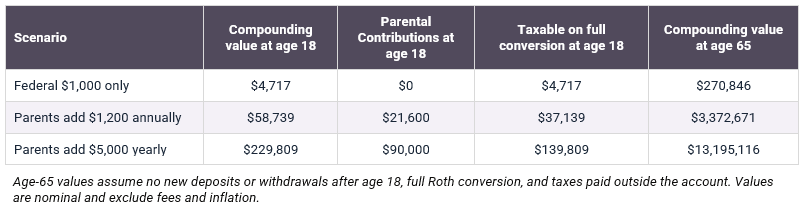
Parents’ personal contributions generally create basis, representing amounts that have already been taxed. The federal $1,000 pilot contribution, certain other contributions, and investment earnings are generally considered taxable “Unearned Income.” On conversion, the taxable portion is treated as ordinary income, not a long-term capital gain. Any partial conversion must include a proportional share of taxable money and basis. It is advisable to retain contribution records.
What might the accounts accumulate?
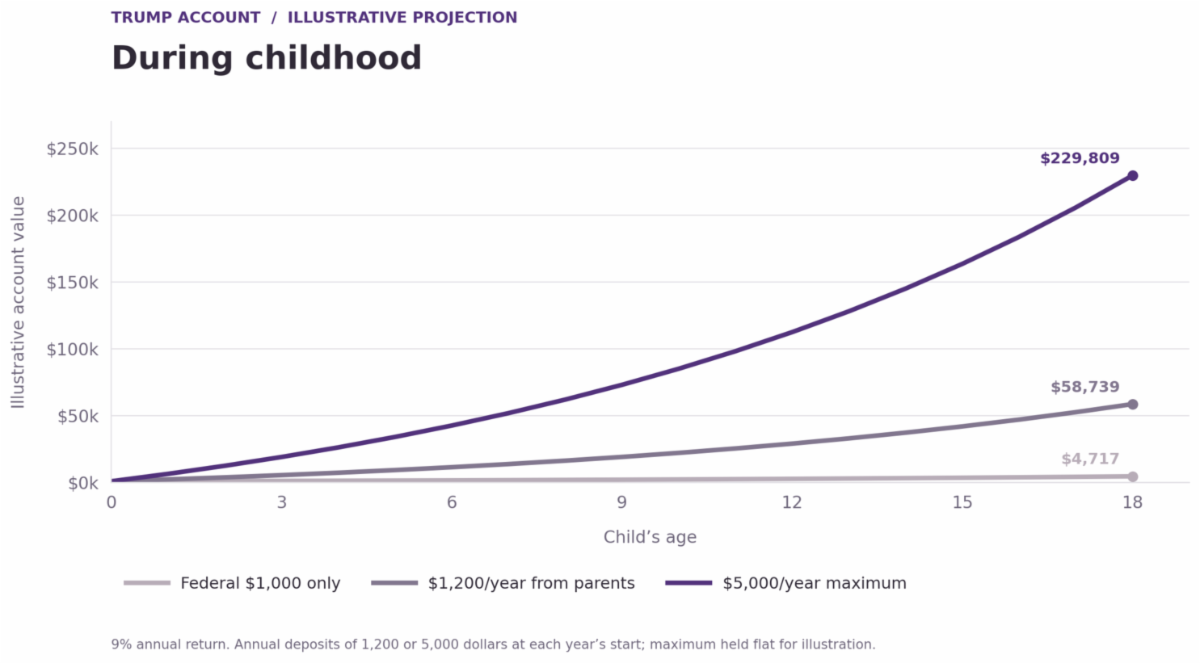
The examples assume an eligible child receives the $1,000 federal contribution at birth and earns a hypothetical 9% annual return. Parental deposits are modeled at the start of each year for 18 years. The $5,000 maximum is held flat for comparison, although the legal limit is scheduled to rise with inflation.
How does the standard deduction affect the conversion tax?
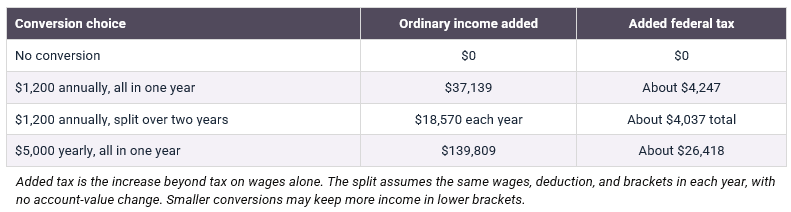
The table assumes an 18-year-old earns $18,000, has no other income, and earns more than half of their total support, so the “kiddie tax” (tax on a child’s investment and other unearned income) does not apply. Using 2026 rules solely for illustration, the $16,100 single standard deduction leaves $1,900 of taxable income. The 10% bracket ends at $12,400, leaving $10,500 of room at that rate. The deduction reduces taxable income; it does not make the entire conversion tax-free.
Potential Retirement Returns
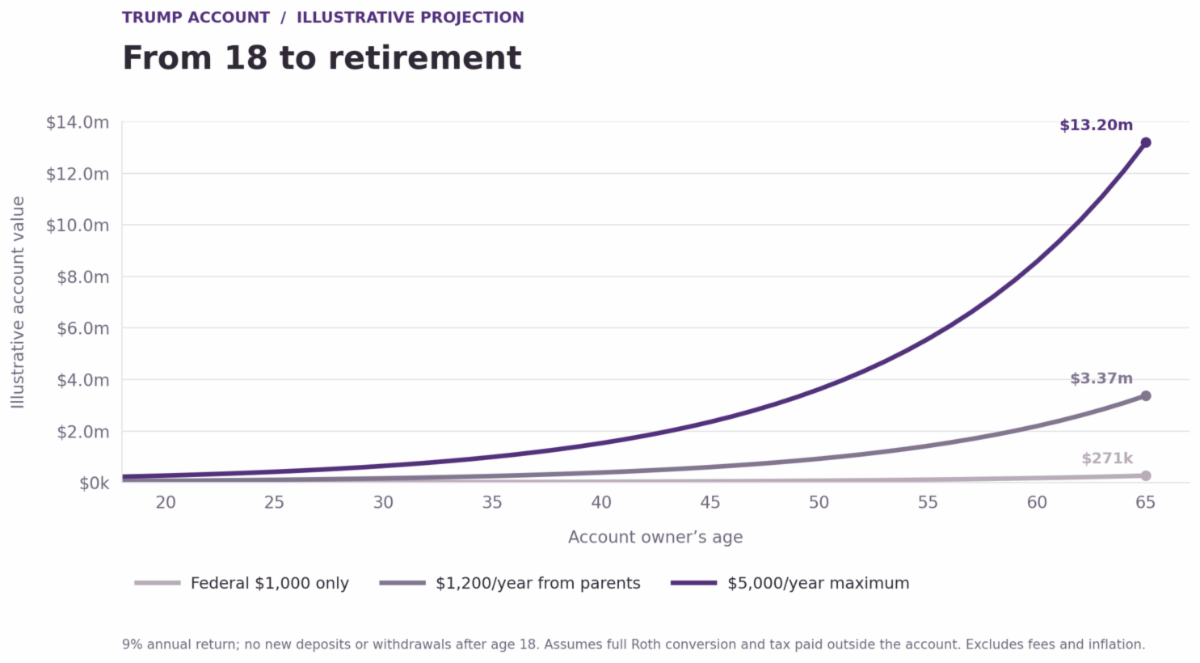
The age 18–65 chart illustrates the potential power of converting a Trump (530A) Account to a Roth IRA early and leaving it invested until retirement. Assuming conversion at age 18, a hypothetical 9% annualized return and no additional contributions, the three scenarios could grow to approximately $270,846, $3.37 million, and $13.20 million by age 65. Once Roth withdrawal requirements are met, those balances, including decades of investment growth, could be withdrawn tax-free. These projections assume conversion taxes are paid separately; actual returns will vary, and the strategy depends on future rules operating as currently understood.
Why is the kiddie tax a major planning consideration?
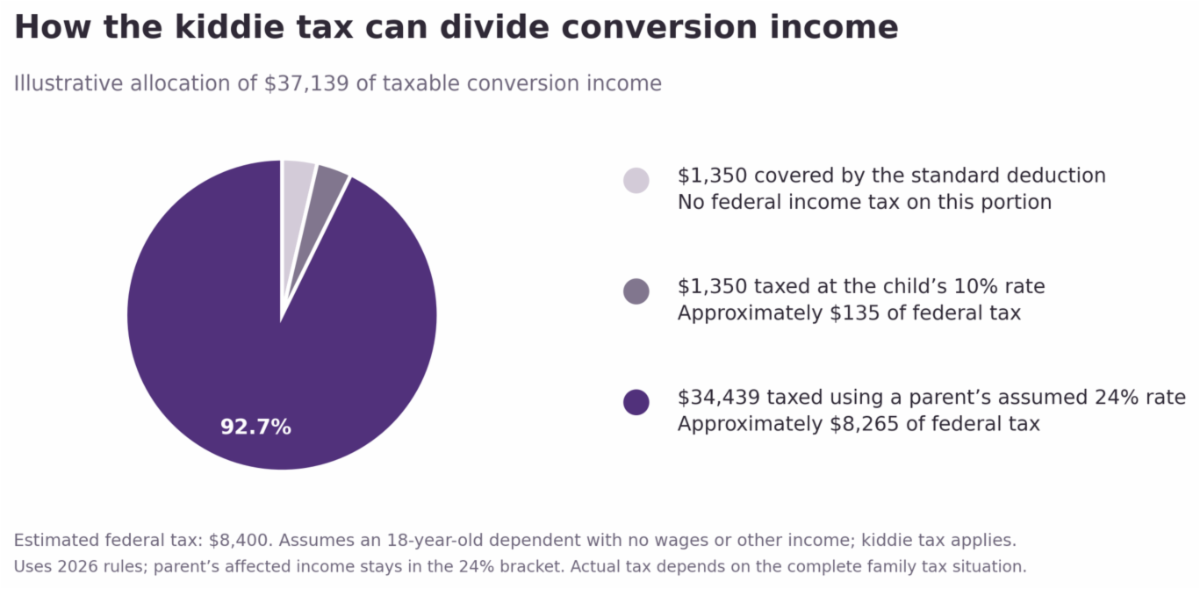
The kiddie tax is a serious potential roadblock: taxable conversion income is “unearned income” and may be taxed using a parent’s higher rate.
Its age rules cover:
Children under 18
18-year-olds whose earned income does not exceed half their support
Full-time students ages 19–23 whose earned income does not exceed half their support
“Half their support” means half the total cost of housing, food, education, medical care and other living expenses; conversion income does not count as earnings from work. Other filing conditions also apply.
Families can consider waiting until these rules no longer apply or converting smaller amounts over several years to use available deductions and lower tax brackets. At age 24, the kiddie tax age test no longer applies. At ages 19–23, it generally does not apply to someone who is not a full-time student. Simply choosing not to claim the child as a dependent does not remove the kiddie tax.
A dependent with little or no earned income generally has a smaller standard deduction. Spreading conversions across years may help, but kiddie tax depends on total unearned income each year. Small balances may favor early conversion; waiting preserves tax-deferred growth but could increase the eventual tax bill. Like any strategy involving tax implications, we recommend consulting with your own tax advisor in addition to your wealth advisor.
The chart below assumes a dependent with no wages.
Does a conversion reduce annual Roth IRA contributions?
No, and this is a major point. Conversion amounts do not count against the annual limit for new IRA contributions, and a conversion does not require wages. A separate Roth contribution generally requires qualifying earned income and is subject to the annual limit and income rules.
What can be withdrawn from a Roth IRA?
After the Roth five-year requirement and age 59½, qualified withdrawals are generally tax-free for any purpose. A qualifying first-home withdrawal can also be tax-free up to a $10,000 lifetime limit after the five-year requirement. Education costs such as tuition and required books may waive the 10% early-withdrawal penalty, but do not automatically make an early withdrawal of earnings income-tax-free. Different rules apply to regular contributions, converted amounts, and earnings.
What should families keep in mind?
This strategy and the projections rely on current law, today’s understanding of the accounts, and an assumed 9% return. Treasury and the IRS have proposed investment regulations; final rules may refine eligible investments and administration. Under current guidance, the special investment restrictions end with the growth period. The new Congress convening in January 2027 could also change the law, although no particular change is assumed here. Investment choices, fees, markets and tax-law changes could materially affect results. Review the current rules and conversion timing with a qualified tax professional before acting.
Hanging out with us in the Plum Tree!
2026-2027 Year End Planning Guide
As we approach the close of 2026, it is an ideal time to review key financial planning opportunities and ensure all year‑end requirements are completed accurately and on time. This guide provides an overview of important deadlines, retirement account considerations, tax‑efficient strategies, and operational reminders to help clients stay organized and prepared.
Retirement Accounts: Contributions, Distributions, and Corrections
Move Money Tool: Year‑end often brings an increase in distribution activity. The Move Money Tool can streamline requests for checks, journals, ACH transfers, and wires. Submitting requests early allows time for review, follow‑up, and settlement, especially when securities must be sold before distributing cash.
Roth IRA Conversions: Converting Traditional IRA assets to a Roth IRA may offer long‑term tax advantages, including tax‑free qualified withdrawals and no future RMDs. Because conversion amounts are taxable in the year of conversion, clients should evaluate the impact on their 2026 tax situation. Completed requests must be submitted before year‑end deadlines.
Tax Withholding: Clients who have moved during the year should update their permanent address to ensure correct federal and state withholding. Withholding for 2026 distributions cannot be adjusted in 2027, so year‑end accuracy is essential.
Required Minimum Distributions (RMDs): Individuals age 73 and older must take RMDs by December 31, 2026. First‑year RMDs may be delayed until April 1 of the following year. RMD amounts are based on prior‑year account values and IRS life‑expectancy tables. Reviewing RMDs early helps avoid penalties for missed or insufficient withdrawals.
LPL’s automated RMD Service can calculate and distribute RMDs annually. Systematic liquidation instructions should be reviewed periodically to ensure they align with updated RMD amounts.
Premier Check Writing: Distributions made through Premier Check Writing are reported based on the date the check is cashed, not written. Because tax withholding is not applied to Premier checks, clients should consult their tax advisor before using this method near year‑end.
Correcting Contributions and Distributions
Clients who make excess or incorrect contributions can correct them through a return of excess or recharacterization. Excess contributions must be corrected by the tax‑filing deadline (including extensions) to avoid a 6% annual excise tax. Specific forms are required depending on whether the client is removing or recharacterizing contributions.
Key Year‑End Deadlines for 2026
IRA distributions: Submit completed forms as early as possible.
In‑kind equity distributions: Allow 2–6 weeks for re‑registration.
Worthless security disposition requests: Submit early to ensure processing.
Backup withholding corrections: W‑8/W‑9 or account applications must be submitted by December 31, 2026.
Trade settlement: Trades must settle by December 31, 2026 to be reported in 2026.
Courtesy 1099 requests: Must be submitted by December 31, 2026.
New qualified plans: 401(k)/profit‑sharing plans must be adopted by December 31, 2026.
IRA Contributions for 2026
The deadline for 2026 IRA contributions is April 15, 2027. Contributions must be postmarked or received by the tax‑filing deadline. Clients should avoid unacceptable check types and ensure account numbers and tax years are clearly indicated.
Recent IRS guidance clarifies that postmarks reflect when USPS takes possession of mail—not when it is dropped off. Clients mailing contributions near the deadline should use trackable or manually postmarked options.
Gifting and Charitable Strategies
Gifting Securities: Gifting appreciated securities can provide tax advantages by allowing clients to deduct fair‑market value while avoiding capital gains. Instructions must be received in good order by December 4, 2026 to ensure year‑end settlement.
Qualified Charitable Distributions (QCDs): QCDs must be completed by December 31, 2026. Beginning in 2027, QCDs will be reported using a new IRS code (Code Y) on Form 1099‑R.
Cost Basis Review
Clients should confirm cost basis information is complete and accurate, especially for transferred accounts or non‑covered securities. Fixed‑income elections should also be reviewed, as they affect Form 1099‑INT reporting.
Tax‑Loss Harvesting
Tax‑loss harvesting can help offset capital gains and improve tax efficiency. The timing of a transaction is particularly important, as both well‑timed and poorly timed sales can meaningfully affect a client’s tax liability and long‑term investment performance. Clients should evaluate harvesting opportunities in the context of market conditions and long‑term goals.
Worthless Securities
Clients wishing to dispose of worthless positions should submit the appropriate form early. Only securities with no transfer agent or trading activity qualify. Actively traded securities, options, private placements, and reorganizing securities are not eligible.
Final Thoughts
Year‑end planning is an opportunity to ensure accounts are properly updated, tax‑efficient strategies are implemented, and all required distributions and contributions are completed on time. Reviewing these items early helps avoid delays, penalties, and missed opportunities.
For a deeper look at planning strategies, important deadlines, and additional opportunities that may apply to your situation, explore the full 2026-2027 Year-End Planning Guide. View the complete guide below.
Celebrating 10 Years of Thanksgiving Pie, Gratitude & Community
Tuesday, November 24, 2026 |1:00 p.m. to 4:00 p.m.
One of our favorite traditions is returning this November, and this year is especially meaningful as we celebrate PlumTree Financial's 10th Annual Thanksgiving Pie Giveaway & Open House (at our new office).
As a small token of our appreciation for the trust and confidence you place in us, we invite you to stop by our office, catch up with our team, and enjoy some holiday hospitality before Thanksgiving.
Choose a complimentary Apple, Pumpkin, or Pecan Pie, or select the donation option and we will make a contribution on your behalf to Food for Others or Pathway Homes.
Whether you are picking up a pie or simply stopping in to say hello, we hope you will join us for this special milestone event and take the opportunity to visit our new office.
To reserve your pie and RSVP, please complete the RSVP link below. Pie orders should be submitted by Friday, November 20, 2026.
Guide to Midterm Elections - How to Invest with Confidence Amid Political Uncertainty
Join us for a timely discussion on what history can teach investors about navigating midterm election years.
We will be joined by a representative of Capital Group, who will explore five key insights from past elections, including market performance, volatility trends, post-election rebounds, and the impact of congressional control on investment returns.
Save the Date! PlumTree Financial's Annual Pie Giveaway and Open House
Stop by our office between 1pm - 4pm and enjoy a cup of hot cider, or hot cocoa, some fall treats...and of course, pick-up your pie (feel free to drop by even if you are not picking up a pie).
Choose from Apple, Pecan, Pumpkin OR choose Donate, and PlumTree Financial will make a donation for the value of your pie to one of the following charities: Food for Others or Pathway Homes.
Deadline to select your pie is Friday, November 20, 2026.
For additional information or to RSVP click link below.
Wall Street derives its name from an actual wall built by Dutch settlers in Lower Manhattan during the 1600s. Over time, the street became synonymous with American finance and investing. Today, "Wall Street" is used as shorthand for the U.S. financial markets and investment industry.
Disclosures
Election Season and Your Portfolio
Securities and Advisory Services offered through LPL Financial, a Registered Investment Advisor, member FINRA/SIPC.
Capital Group is not affiliated with or endorsed by LPL Financial or PlumTree Financial.
Historical election and market data compiled by Capital Group. Past performance does not guarantee future results.
This material is provided for informational and educational purposes only and should not be construed as investment, tax, or legal advice. Investing involves risk, including the possible loss of principal. Past performance is not indicative of future results. Historical market trends and election-cycle data are presented for illustrative purposes only and should not be relied upon as a predictor of future market performance. Investors should consider their individual circumstances, objectives, and risk tolerance before making investment decisions.
Sources:
1-5: Capital Group, "Investing Through Elections"; Fidelity Investments election cycle research; Bloomberg market data; Standard & Poor's historical S&P 500 returns data.
Trump Accounts
This material is provided for informational and educational purposes only and is not intended to provide individualized investment, tax, or legal advice.
The information presented regarding Trump Accounts, Roth IRAs, Roth conversions, and related tax considerations is based on rules and guidance believed to be current as of the date of publication, but tax laws and regulations are subject to change and their application may vary based on individual circumstances.
Trump Accounts offer tax deferred growth on earnings and provide tax free withdrawals when distributions are qualified. Contributions may include after tax family contributions, pre tax employer contributions, and a one time $1,000 federal contribution for eligible children born between 2025 and 2028. Withdrawals prior to age 59½ may result in a 10% IRS penalty tax, in addition to current income tax, and may be restricted until the child reaches age 18.
Annual contribution limits and other restrictions apply. Some Trump Account rules and regulations are still forthcoming from the U.S. Treasury and IRS. Clients should consult with a qualified tax advisor or financial professional before making any decisions.
Readers should consult with their tax and legal advisers before taking action based on the information presented. A Roth conversion may have significant tax consequences, and whether a conversion or other strategy is appropriate depends on an individual’s circumstances, including income, tax bracket, age, account balances, anticipated future tax rates, and other factors.
Any examples, projections, or illustrations are hypothetical and are provided solely for educational purposes. They do not represent actual client results or guarantee future outcomes. Investment involves risk, including the possible loss of principal.
Securities and advisory services offered through LPL Financial (LPL), a registered investment advisor and broker-dealer (member FINRA/SIPC). Insurance products are offered through LPL or its licensed affiliates. To the extent you are receiving investment advice from a separately registered independent investment advisor that is not an LPL affiliate, please note LPL makes no representation with respect to such entity.
Sources :
IRS Notice 2025-68; Publications 590-A and 590-B; Form 8615 instructions and Topics 551 and 553; IRS 2026 inflation adjustments; IRS Topic 309; proposed Trump Account investment regulations announced August 20, 2026 (IR-2026-96).
Trump/530A account rules. IRS, Notice 2025-68, Section II and Q&A G-1. Covers the childhood growth period, contribution limits, the $1,000 pilot payment, basis, proportional taxation, and Roth conversions after the growth period. irs.gov
Roth conversions and contribution limits. IRS, Publication 590-A, “Converting From Any Traditional IRA Into a Roth IRA” and “How Much Can You Contribute?” Covers conversion taxation and the separate rules for annual contributions, including earned-income requirements.
Roth withdrawal rules. IRS, Publication 590-B, Roth IRA distributions section. Covers qualified tax-free withdrawals, five-year requirements, first-home purchases, education exceptions, and the different treatment of contributions, conversions, and earnings. Internal Revenue Service
Kiddie tax and 2026 tax figures. IRS, Topic 553 and Revenue Procedure 2025-32, Sections 4.01, 4.02 and 4.14. Covers kiddie-tax eligibility, tax brackets, the $16,100 single standard deduction, and the $1,350 minimum dependent deduction. Tax examples use 2026 rules for illustration. Internal Revenue Service
Projection and calculation assumptions. Calculations by PlumTree Financial. Illustrations assume a $1,000 initial deposit, 18 years of growth, parental contributions of $0, $1,200 or $5,000 deposited at each year’s beginning, and full Roth conversion at age 18. Retirement projections assume another 47 years of growth, no additional deposits or withdrawals, and conversion taxes paid separately. Figures exclude fees and inflation and are rounded. The two-year conversion example assumes no intervening account growth. The kiddie-tax example assumes the parent’s affected income remains in the 24% bracket.
2026-2027 Year End Planning Guide
LPLtracking#1166166
This material was prepared by LPL Financial, LLC.
Securities and advisory services offered through LPL Financial (LPL), a registered investment advisor and broker-dealer (member FINRA/SIPC). Insurance products are offered through LPL or its licensed affiliates. To the extent you are receiving investment advice from a separately registered independent investment advisor that is not an LPL affiliate, please note LPL makes no representation with respect to such entity.
Not Insured by FDIC/NCUA or Any Other Government Agency
Not Bank/Credit Union Guaranteed
Not Bank/Credit Union Deposits or Obligations
May Lose Value
This information is not intended to be a substitute for specific individualized tax advice. We suggest that you discuss your specific tax issues with a qualified tax advisor.
Securities and Advisory services offered through LPL Financial, a Registered Investment Advisor, Member FINRA/SIPC. Insurance products offered through LPL Financial or its licensed affiliates.
All information is believed to be from reliable sources; however, PlumTree Financial makes no representation as to its completeness or accuracy.
PlumTree Financial, Inc. | 8100 Boone Blvd. Suite 420 | Vienna, VA 22182 US